

Death Trip

an excerpt from The Funeral Militia, a novel in progress
Could you photograph one at a time.
--Carrie
Hurt, Tennessee
July 2023
Fire is a tender thing. This thought—not in words, exactly—comes to Lawson, home from college for the summer, as he sits on the floor in reception room number one of Laurel Grove Funeral Home. He’s painting the fireplace’s metal framing (black), thinking about all he’s learned from Mr. Gibby about building fires, about lighter wood, about starting very small, leaving some room for oxygen.
Lawson’s Aunt Ella comes to the wide door and says, “They’re here. Mr. Gibby is meeting them in the parking lot.”
Lawson follows her into a fairly large meeting room with a centered, round table, and nice chairs with arms. Five chairs have been placed around the table. Lawson knows that Mr. Gibby, his great uncle, called Mr. Gibby by most people who know him, will be doing the grief counseling. Aunt Ella will handle the business part of things.
Ricky Lawrence was killed yesterday in a motorcycle accident. This will be Lawson’s first time in one of these meetings. Aunt Ella has asked him to take notes. He takes a seat at the table.
Ricky’s wife, Carrie, and then Ricky’s mother, Rachel, enter the room. Lawson stands. Then Aunt Ella and Mr. Gibby enter.
Ricky was alone, his neck broke, and no one else was injured. He is now in the Tree Room, a euphemism for the preparation room.
Carrie is tall and solid looking. Rachel is small, thin. They both are dressed in black. Rachel wears a small wooden cross on a leather string around her neck.
As Mr. Gibby introduces everyone, Lawson sees as they sit that they both have been crying. They each have a Kleenex in hand.
“This is always very hard,” says Mr. Gibby. Lawson cannot help but wonder what Ricky looked like when Rachel first saw him, if he was dead when the rescue squad got there, where exactly on Baldwin Road it happened, if there are photographs of the motorcycle, if it slid out from under him or hit a tree or something head on, if they believe in the resurrection of the body, if they will choose cremation, if there will be an open casket. He counts backward from 100 to calm his mind. He notices that if he photographed Carrie, the lamp behind her would have to be turned off and moved to the side, out of the frame.
Lawson’s notes—kept in a green, three-ring binder:
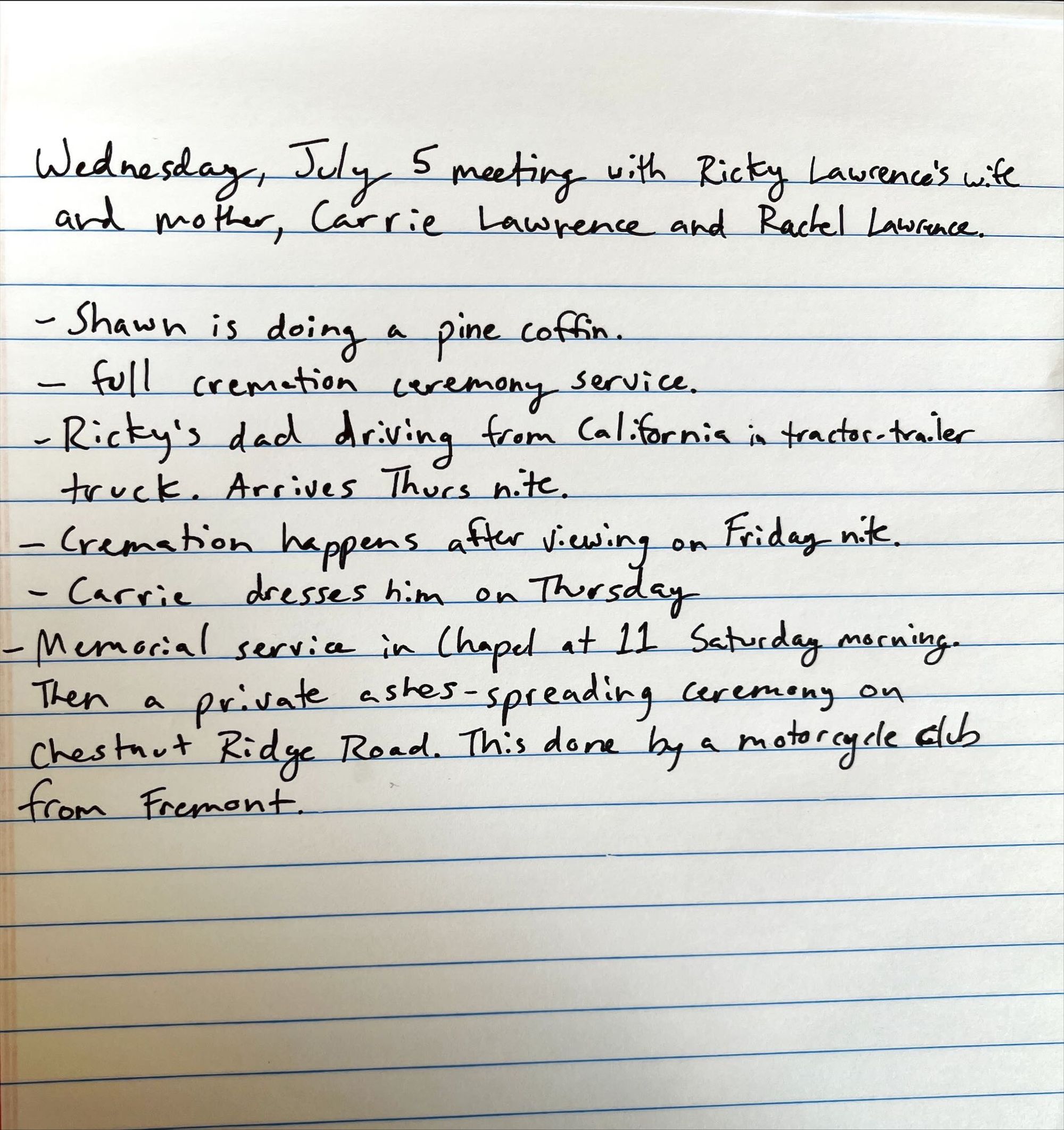
After the meeting, Lawson and Mr. Gibby walk with Carrie and Rachel out to their car–an older, tan Camry. Carrie gets in the passenger side while Rachel speaks to Mr. Gibby as they both stand by the driver’s door. “Mama is going to want to come by tomorrow, but she’s not going to be able to come in. She can’t hardly walk and . . . and she’s fixated on this thing called a funeral militia funeral, but I’ve told her that that don’t happen in this day and age, and Rupert will be driving in tomorrow and he’s done said on the phone that it’s got to be cremation and that’s all his family has ever done and so that’s what we’ll do, and so there won’t be a graveside service of any kind. There won’t even be a grave. They’ll be spreading the ashes—the motorcycle club, like Carrie said. But we get to have a Christian service with Preacher Zellinger from that church down in Baldwin where Ricky and Carrie go . . . went sometimes.”
Mr. Gibby says, “The last funeral militia funeral was in ’71, as I recall. That would likely cause some trouble.”
“Mama remembers that, but I’d just been born.”
“We will take care of everything, Ms. Lawrence.”
Mr. Gibby heads back inside as the Camry drives away. Mr. Gibby retired a year ago at age 75, but he keeps a small office in back. He comes to his office most days, and when he doesn’t, this summer, it’s Lawson’s and Aunt Ella’s job to feed his two yellow canaries, Birdy and Birdy—and also keep their cages clean. Lawson does odd jobs around the funeral home—no embalming or view-prep, but he did have to dress a child during a rushed week earlier this summer.
On Thursday, as Lawson finishes up painting the fireplace frame, Aunt Ella comes to the reception room door. “Ricky Lawrence’s wife will be here in about twenty minutes. She just called. Mr. Gibby wanted to be sure one of us was around in case he’s not back from Knoxville. I’m pretty tied up with paperwork.” Lawson visualizes the interior of the Tree Room, the gurneys, the one with the body, covered.
Lawson is okay with the job. He especially likes—at funerals—the traffic directing part. Uncle Bruce is licensed, and Aunt Ella more or less runs the business—payroll, ordering caskets, flowers, and so forth. Ronnie, his cousin, helps, but he’s not on the payroll. Lawson is.
Mr. Gibby makes it back from Knoxville just as Carrie arrives, and he and Lawson meet Carrie in the reception room. Mr. Gibby says, “You have our condolences, Carrie. It's a hard time, and Ricky was a fine young man.”
“Thank you,” says Carrie.
“You met Lawson yesterday.”
“I’m so sorry about your loss,” says Lawson.
“Thank you,” says Carrie. “He was—he was mighty fine.” She studies the old man--tall, white-headed, with a little goatee like that guy attacking the windmills. She keeps thinking there is some way out of this, that it’s an odd, deep trick or dream, but she has seen Ricky at the hospital, dead, and held his hand and put her head to his chest, and now: there stands the undertaker. He, or somebody, embalmed Ricky last night, or maybe this morning. Embalmed. The fluid. And in a few days that precious body will be white ashes.
The young man with Mr. Gibby, Lawson, the helper who was taking notes—she places him: she’s seen him selling photographs at the Farmers Market in Baldwin. Wait . . . maybe he could make the tattoo photos. “I think I’ve seen you selling them framed photographs at the Farmer’s Market.”
“That’s me.”
As Lawson, Mr. Gibby, and Carrie enter the Tree Room, Lawson sees that Ricky’s body is under a sheet—and no other cadavers are in the room. He can’t see the waterproof pad beneath Ricky’s body, but thinks about it. Carrie pulls the sheet from Ricky’s face, touches his cheek, and says to Lawson, “Could you take some photos of Ricky’s tattoos for me?”
Lawson thinks about camera settings, indoor lighting. He can’t say no. He thinks about the book that Dr. Kingsley, his professor, showed him—with photos of dead people and short newspaper clips, all from a little town somewhere in Wisconsin. The title was Wisconsin Death something. “Sure,” he says. “I’ll …” He looks at Mr. Gibby, who nods “okay.”
“I’ll go get my camera,” says Lawson.
“Would that be okay?” Carrie asks Mr. Gibby.
“Excuse me?”
“Would that be okay?”
“Sure. I’ll be just down the hall in my office if you need me.”
Lawson walks out to his mom’s old Tacoma and gets his Nikon. On the way back in he’s telling himself to just relax and go along with Carrie—her wishes, whatever. Dr. Kingsley stressed how norms (“unwritten rules for appropriate behavior among a particular group in a given situation”—he had to memorize it) may create anxiety among those not in the particular group. So many of the people who he’s met at the funeral home have a different set of norms than is apparent in his new university life. He knows he grew up with far more conservative norms than those he’s felt at the university, but Dr. Kingsley, his English teacher, has cautioned him to observe norms and think about them, and try not to be judgmental.
Walking back into the Tree Room, Lawson notices—on a table close by the gurney—photos: wedding, graduation, a photo of four smiling football players holding helmets by their sides.
A CD player and several CDs rest on the table. It’s been awhile since Lawson has seen a CD player. He immediately visualizes a mobile home.
“Miss Ella let me set this up last night,” says Carrie. She hovers over Ricky, whose arms are outside the sheet. She takes his hand in hers.
Lawson thinks: It’s almost pure cold in here.
Carrie pulls the sheet down to Ricky’s waist. "He loved that old CD player,” she says. “There ain’t a mark on him. His neck broke.” For Carrie, this cold room is now the only room on earth.
Lawson can tell that Mr. Gibby and/or Bruce wired Ricky’s mouth shut.
“I wanted the music in here, too,” says Carrie. “Thank you for doing this. I couldn’t stand it alone. I’m glad we picked Laurel Grove. That funeral home down in Baldwin is too fancy or something. His mama and grandma wanted it up here, too. Ricky rode all through in here on his motorcycle and he’s always said what he wanted when he dies. I was surprised he ever talked about such but it must have been some sort of premonition. The whole cremation ceremony after a church service. He’s in a motorcycle club and they are going to spread his ashes from that curve over the Christmas tree farm on Chestnut Road. You know the place I’m talking about?”
“I do.”
Lawson notices that Ricky’s hair has been combed to a shine. He's very white, with maybe the slightest blue tinge. Two bluebirds are tattooed on his chest—one on each side. A Japanese writing tattoo encircles his right arm below his elbow. “Simper Fidelis” is tattooed onto his shoulder.
“Was he a Marine?” Lawson asks, and he thinks of that book again. Wisconsin Death something.
“Oh no. He wanted to be a Marine or in the Army Rangers. But he had asthma and they wouldn’t take him. I almost said ‘has asthma.’” The look on her face is a kind of vague, strong stare.
Lawson is remembering the photo of a little girl in that Wisconsin book, dead and resting in a small, open coffin that is leaning upright against a wall. A man stands beside her, but you only see him from the waist down. That photo is in the book twice. Lawson visualizes the almost loving way his granddaddy and Uncle Bruce lift a dead body into a casket, cradling the head—or sometimes, in case of cremation, rolling a gurney carrying a bagged body into one of the vans—the legs of the gurney magically folding up beneath. Lawson has transferred some bodies down there—and had to help unload one. He held the ankles through the bag.
Carrie says, "This groaning noise come out of him up in the hospital. Twicet. Even though he'd already passed. They said it's normal.” She wipes her nose with the back of her hand. “Could you start with pictures of them bluebirds first?" She looks to the ceiling, “Oh, God. It’s just so hard to bring in his clothes. I tried but I couldn’t. I just . . .” She puts her hands over her face again, but keeps talking. "Lord God. It’s just hard to bring in his clothes . . .”
“Do you want me . . . to? Somebody here will dress him, you know.”
“No. No. I want to. And oh my God, I never . . . I never knowed a man could get a woody right when he dies."
A woody? thinks Lawson. Is she . . . is she talking about an erection?
Carrie places a hand on Ricky's chest and cries softly, her other hand over her eyes. "I Googled it to see if it was normal, ‘cause I thought maybe it was just Ricky being Ricky. He could do just about anything. Turns out, it ain't all that unusual. There was this war one time and all these dead men were on a battlefield and all these women went out to try to get pregnant, because of all the woodies. I guess they just wanted children so bad. And I ain’t told many people, Lawson . . . but I’m pregnant.”
Lawson feels that he is in a kind of place he’s never been, a place with dark spaces above, below, to the left and right, front and back, kind of closing in. Carrie moves around the foot of the gurney, straightening the sheet. She looks up. “That looks like a nice camera. What kind is it?”
“Nikon.”
She steps over and turns on the CD player. "I don't know a hundred percent that he can't hear that. He loved Tom Waits for some reason I could never understand." Lazy trip to heaven on the wings of your love. Banana moon is shining in the sky . . . “After you get them bluebirds, I want you to take a picture of some crosses, too.” Carrie pushes the sheet farther down, revealing three crosses that are low—very low—on Ricky’s stomach, side by side. God’s Nation Militia is tattooed in a Gothic print across their tops. The longest and biggest cross, the middle one—at its bottom—enters pubic hair.
“They’re thinking,” says Carrie, “they might have to go to war if the elections get messed up next year, but they would have to volunteer to do that—it’s not mandatory, and Ricky has never been . . . was never . . . you know, a joiner. And this whole militia thing is a secret. They say they’re against the law . . . or they might be. I don’t know. He never has filled me in, except they are not going to do anything. They are just sort of ready to get prepared. Please don’t tell anybody. Will you please not tell anybody?”
“I won’t tell anybody.” War? Lawson is thinking . . . And . . . Lawson is looking at that very low down tattoo of the middle cross and thinking that when that one was done—it extends below the others—Ricky must have been shaved down there and . . . wait, a right-wing militia group. With a motorcycle club as cover. In Baldwin?
Carrie asks, "Could you make a photograph of just one bluebird, then the other, then both, and then the crosses down below, and then one of everything together, from kind of high up—with just his chin in the picture? I don’t think I want his face in those, or maybe at all. I don’t know. What do you think?”
“Well, I don’t know.” Lawson is remembering another photo from that book. “That’s kind of up to you.” Lawson looks around. That standing lamp should be moved closer. Maybe I shouldn’t be doing this, he thinks. God’s Nation Militia. But he needs the camera straight above the tattoo to make the photos. He moves the lamp to a place near Ricky’s shoulder, then moves it away a bit.
Three stools stand over against the wall—soft, light-brown padding on top of each. He can stand on a couple of those. “I can use a couple of those stools for the high-up shot,” he says. Militia?
"His mama loves bluebirds more than anything," says Carrie. Her hand rests on Ricky's arm. "He's so cold."
Lawson thinks, I hope so.
He places two of the stools side by side, near Ricky’s shoulder, slips off his shoes. The camera swings from a strap around his neck. He gets up on his knees and then slowly stands on both stools. It’s not easy, exactly. He glances down at the bluebirds. A militia? He concentrates on keeping his balance, looks at the small digital screen on the camera.
The door to the room clicks open.
Lawson looks, being careful to keep his balance on the stools. There stands Ricky’s mother, and around her neck: the small wooden cross on a leather string. She doesn’t seem old enough to have grey hair. She is looking at Ricky as she moves into the room. Mr. Gibby moves in behind her. He wears a confident, slight smile, holding his wrist in his hand.
Rachel starts sobbing quietly and drops to one knee. Mr. Gibby steps around, holds an arm to help keep her steady, then helps her to her feet. She steps over to Ricky, bends and kisses him on the forehead and says, “I love you, Punkie. Oh, my Lord above.” She wipes away tears with a Kleenex, turns to Mr. Gibby, “Mama’s in the truck. Can you step out and speak to her? She said she wanted to see you. She didn’t want to come in because of her troubles, which kind of surprised me, and which is kind of a blessing, I guess. She’s the one insisted on a wood coffin, you know, for the viewing. She pushed for an open casket which is okay with me. We had to work all that out with her when we told her he was getting cremated.”
“I’ll be glad to step out and speak to her. Sure.” Mr. Gibby turns, leaves. The door clicks shut.
“We’re taking some photographs, Rachel,” says Carrie. “Or Lawson is. I just said how much you loved bluebirds.”
Lawson starts getting down from the stools.
“You must be some of Mr. Gibby’s people," says Rachel. "I see the favor. I noticed yesterday.”
Lawson, now on the floor, says, “Yes, ma’am. He’s my uncle. Great uncle.”
“Did you know Ricky?” Her eyes are bloodshot.
“No ma’am. I did not.”
Lawson climbs back up on the stools, the camera hanging from the strap around his neck. He takes several photos of the bluebirds, from high up and then closer—birds together and as singles.
Rachel watches, then says, “I’m gonna be going. I can’t . . .” She moves over and hugs Carrie. “Do you want to come out and say hey to Flossie?” Rachel asks.
“Just tell her I said hey, and that I’m sorry we can’t do one of them funerals.”
“I’ll tell her.”
Outside, in the front parking lot—smaller than the back one—Mr. Gibby walks up to the passenger side of the Camry. He knows Flossie, a second or third cousin. He’s lost track of the specifics. She sits with her window down, looks up at him. There is a garden-pea mole on her chin—from which a single, short hair grows. She wears a brown wig that shows a clip of grey hair from beneath it. “Hey, Flossie,” says Mr. Gibby. Darrell Hackney was her daddy—the one got into trouble, way back. World War I. That store in there, in Yardley Cove—and that house where somebody got shot in a hidden staircase. She was one of the Hackneys at the graveyard decoration days—when they used to do that.
Flossie looks up, “Hey, Gibby.”
“How you doing?”
“I’m okay.” He’s the one everybody calls Gibby. She can’t keep the brothers straight. “It’s a shame,” she says, “about all the cremation stuff. What do you think about it?”
“Excuse me?”
“The cremation stuff. What do you think about it?”
“Well, it’s like anything else. Enough people get a notion, and something makes a slow but steady take-off.”
“Yeah, well, if my daughter hadn’t a married a Lawrence, there wouldn’t be any of that going on amongst my offsprings.”
“Among my . . . ?”
“Among my offsprings. You need to get hearing aids, Gibby. I love mine . . . somebody in your line of business. Costco, down in Baldwin. They do the works.”
"You’re right. I’m going to get my nephew to go with me to get a set. But I’m retired now, so it’s not so urgent.”
“Lord, I heard the birds for the first time in years when I got mine.” She puts her hand behind her neck, takes a deep breath. “I wanted a funeral militia funeral for Ricky, Gibby. It was ordained for my family—after all Daddy went through. You know that—or ought to.”
“He did go through a lot. A lot of people went through a lot of stuff, but it was considered disrespectful by the veterans and some of those groups, I think. And the law—it’s against the law.”
“I don’t think it was, but I don’t want any argument. I just know that’s what I want for me.”
Mr. Gibby sees a kind of scrubby dot or spot somewhere on a 1921 calendar and then on a 1971 calendar—the funeral militia times he knows about. He quickly does the math. Another is about due, with history repeating itself and all. “Here comes Rachel. I’ll see you later, Flossie.”
“Bye bye, Gibby.”
Rachel gets in behind the steering wheel. Flossie asks her, “How does he look?”
“He looks as good as you can expect. Oh, my God.” She puts her face in her hands.
“I’m sorry, Sweetie,” says Flossie. She reaches over.
“Carrie’s got Mr. Gibby’s nephew in there taking pictures of his tattoos.”
“That . . . sounds a little perverse to me,” says Flossie. “When do they burn him?”
“Oh, God,” says Rachel. She puts a crumpled tissue up to her nose and blows.
“Well, I’ll tell you one thing,” says Flossie, “I’m going to find somebody to give me and Grace a funeral militia funeral. That’s what Daddy would want.”
Inside, Carrie asks Lawson, "Can you get the crosses all together?"
"Sure.” Lawson moves the stools toward Ricky's feet.
Each cross is blue with a narrow white, and then a red, outline.
"Could you photograph one at a time?" asks Carrie.
“Sure.”
“I was with him when he had them crosses done and . . . listen, can you wait just a minute? I'm thinking we need to shave a little there at the bottom of that middle cross. We need a ‘lectric razor. Do y’all have one?”
“I’m just thinking that nobody’s going to see, right? I mean, it’s up to you, but–”
“I’m thinking about the photograph. This will be kind of my last chance. I want it to be clear. I was with him when he had that done in Knoxville.”
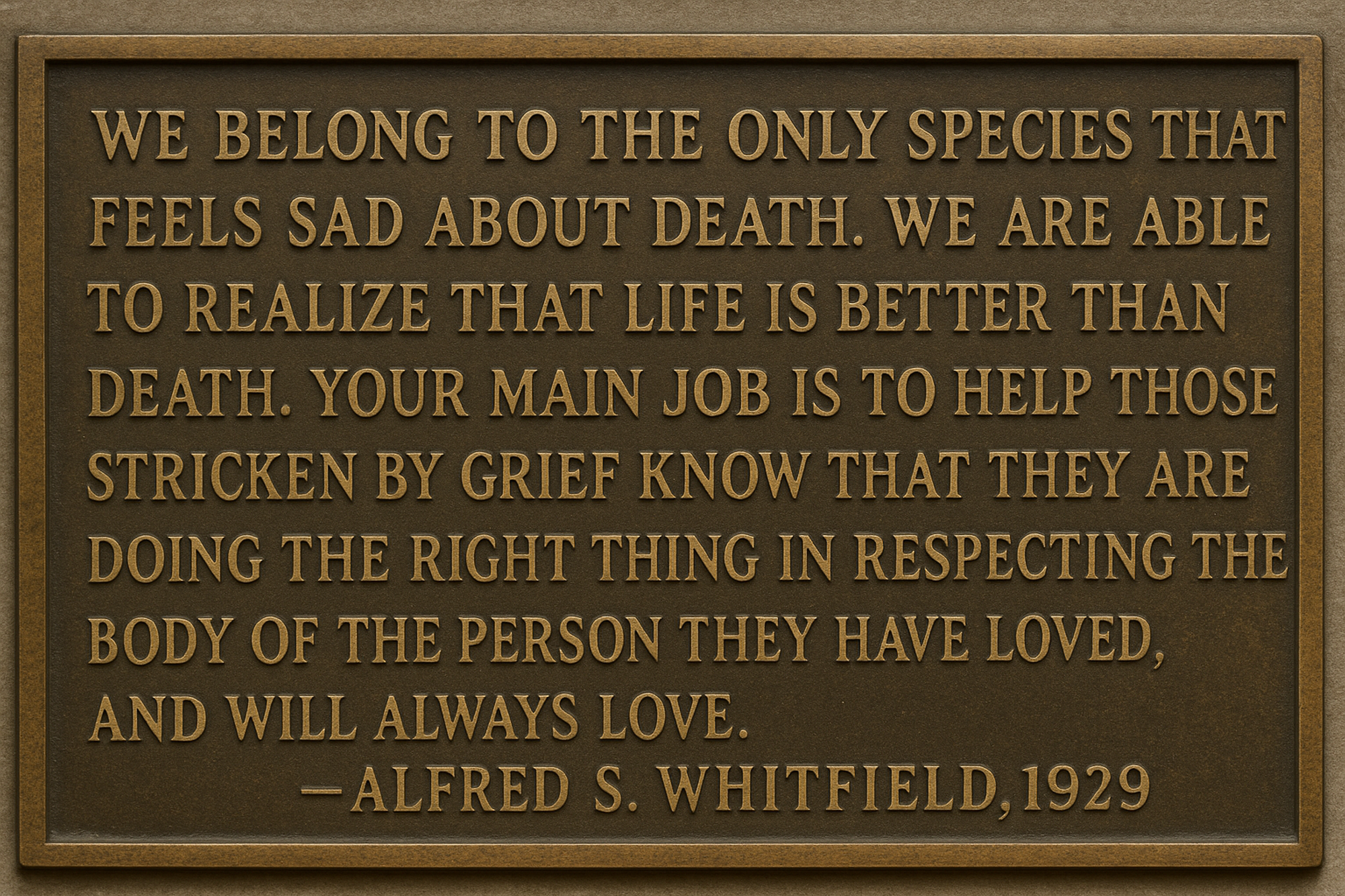
“Sure. Okay.” Lawson heads to Mr. Gibby’s office, walks behind his desk and glances at the plaque on the desk, deciphering how he fits into the expressed sentiment in the message.
He looks in a wall cabinet for an electric razor or trimmer and is about to look in another cabinet when Mr. Gibby comes in from the parking lot. Lawson turns and says, “We have something like a beard clipper, don’t we?”
“We do. There’s one in a drawer down there in the Tree Room. I got one here, too. That top drawer under Birdy’s cage.”
Lawson finds the clipper, clicks it on. It hums. He turns it off.
"His hair looked pretty well cut to me,” says Mr. Gibby.
“This is his, ah . . . He has a tattoo she wants me to photograph. It’s between his belly button and . . . Down there.”
“I didn’t see that. Maybe Bruce did. What’s the tattoo?”
“Three crosses.”
“Three . . . ?”
“Crosses?”
“That’s it?”
“Well . . . it’s got printed across the top of them “God’s Nation Militia.”
“Notion?
“Nation.”
“Nation? Really. ‘God’s Nation Militia’?”
“Yessir.”
In the Tree Room, Lawson hands the trimmer to Carrie. She goes to work. Lawson steps over to the table with the photos and CD player, looks at the football photo, the graduation photo, and waits.
“Now, that’s better,” says Carrie. “He’s ready. Do you know if y’all have a little handheld vacuum, Dustbuster, or whatever?”
Lawson thinks about dust from scattered ashes. “I’ll ask Mr. Gibby. I’ll take the trimmer back.”
In Mr. Gibby’s office, Lawson asks Mr. Gibby, “Do we have a Dustbuster? I know about the big vacuum, but . . . “
“Dud . . . ?”
“Dustbuster, or Dust Devil, or something like that. Hand-held vacuum.” Lawson holds up a gripped fist.
“No, we don’t have one of those. The big Hoover with hose and attachments is in the kitchen closet if that’ll work.”
“That should work.” Why do we have a kitchen? thinks Lawson. I don’t remember that stove being used, ever. Just the refrigerator and microwave.
Lawson, back up on the stools after the use and return of the Hoover to the kitchen closet, frames and shoots each cross separately, then shoots them together.
“I'm going to get some of them pictures printed on canvas, 8 by 10,” says Carrie. “We kidded about it one time. And I never thought . . . I never thought . . . and our talk about the ashes being scattered over the cliff on Chestnut Road—it was . . . was just for the fun of it.”
Lawson again thinks of that Wisconsin book.
Carrie kisses Ricky on the cheek, pulls the sheet up over his chest, then over his head. “Can I ask you to do one more thing before you get down?” she asks.
“Sure.” Lawson is on the stools, on one knee.
“Just take one more photograph. No. Two. From up there.” She pulls a gurney up beside Ricky’s, picks up the folded sheet at the foot, climbs onto the gurney, arranges the sheet so it’s over her and up to her chin. “I’m thinking do one with my face showing, and one with it covered, and then I can decide which one to keep.”
Shawn, the coffin maker, sits outside in the parking lot on the open tailgate of his pickup. A couple of guys are with him, dressed in leather, leaning against the truck bed. Two motorcycles are parked nearby. In the truck bed is a pine coffin for Ricky.
Carrie and Lawson walk out, and in a minute they all stand looking at the coffin. Mr. Gibby walks up, stands with them, silently.
Shawn speaks. “I try to keep a couple of spares. Good white pine. It’s lighter and a little easier to work with than the long leaf.”
Mr. Gibby reaches in and touches the coffin, turns to look at Carrie. “I like it when a family takes a funeral personal.”
Clyde Edgerton
Clyde Edgerton, from the community of Bethesda near Durham, North Carolina, is the author of ten novels, a memoir, and a book of parenting advice. Seven of the novels have been adapted for stage and/or screen, and five have been New York Times notable books. His most recent awards are a 2025 O. Henry prize and the 2025 North Carolina Writers Conference Award. Edgerton lives in Wilmington with his wife, Kristina.
Carson Monahan
Carson Monahan (b. 1985, Ann Arbor, MI) received a BBA from Eastern Michigan University, Ypsilanti, Michigan. Recent exhibitions include Conduit Gallery, Dallas, TX; Monument, Kingston, NY; and Monya Rowe Gallery, NYC. Recent press includes New York Magazine, The Wall Street Journal, and Artforum.
Monahan is a self-taught painter living and working in Detroit, Michigan. His work merges contemporary narratives with echoes of classicism and surrealism, exploring the multifaceted human condition. Monahan’s works aim to delve into the realms of human emotion and thought, unveiling connections between psychological landscapes and the spiritual dimensions of existence. He is represented by Monya Rowe Gallery in NYC.